Checked against FTC and Facebook reporting guidance: July 2026. Reporting portals and bank rules can change; the sequence below is what matters most.
What to Know
- Speed decides recovery. Call your bank or card issuer’s fraud line first — a card charge disputed quickly can be reversed; app payments (Zelle, Venmo, Cash App) usually can’t, but report them anyway.
- Report in three places: the listing and seller’s profile on Facebook, the FTC at reportfraud.ftc.gov, and the FBI’s IC3 at ic3.gov. Add a local police report — many banks require the report number.
- If you shared any personal details or a code, treat it as an identity risk: change your Facebook password, turn on two-factor login, and lock down your credit.
Getting scammed feels awful, but the next two days matter more than what already happened. Work this list in order — the money steps first, because those are the ones with a clock on them.
Do these now, in order
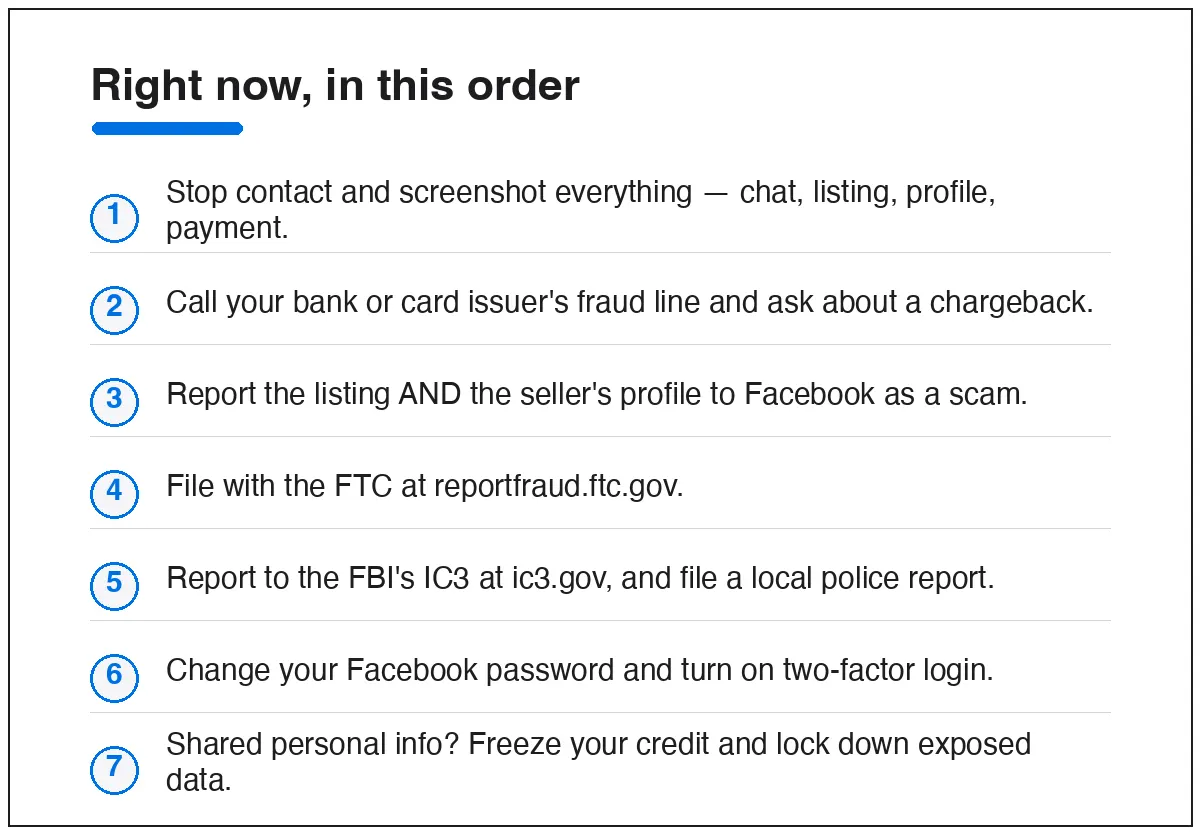
1. Stop contact and save the evidence
Don’t keep arguing with the scammer — it tips them off and changes nothing. Screenshot everything first: the chat, the listing, the seller’s profile URL, and any payment records or “receipts.” You’ll need these for every report below.
2. Call your bank or card issuer
Ask for the fraud department and say you were defrauded in a Marketplace transaction.
- Credit card: your strongest position. Chargebacks are typically available for 60–120 days.
- Debit card: still call immediately — protections are weaker but time-sensitive.
- Zelle / Venmo / Cash App / wire: usually treated as authorized and hard to reverse, but report the fraud so it’s on record and any freeze that’s still possible can happen.
3. Report to Facebook
Open the listing, tap the three-dot menu, and choose Report › flag it as a scam. Then open the seller’s profile and report that too. Reporting both helps Facebook remove the account and can protect the next person.
4. Report to the FTC
File at reportfraud.ftc.gov. It won’t recover your money directly, but it creates an official record, feeds fraud-pattern tracking, and is sometimes requested by banks.
5. Report to IC3 and local police
File with the FBI’s Internet Crime Complaint Center at ic3.gov, and file a report with your local police (many use an online portal). Banks and card issuers often want a police report number before processing a fraud claim.
6. Secure your account
Change your Facebook password and turn on two-factor authentication. If you clicked a link or entered credentials anywhere, assume that password is burned and change it everywhere you reused it.
7. If you shared personal info, lock it down
Gave out your address, date of birth, or a verification code? Treat it as an identity-theft risk. Consider a credit freeze with the three bureaus (free, and reversible), watch your statements, and reduce how much of your personal data is floating around on data-broker sites — the less that’s exposed, the harder you are to target again.
Quick answers
Can I get my money back after a Marketplace scam?
Best odds are a credit-card chargeback filed quickly. Debit is weaker; Zelle, Venmo, Cash App, and wire transfers are usually not reversible — which is why reporting fast still matters even when reversal is unlikely.
Does reporting to Facebook get my money back?
No, but it can remove the scammer and is a required part of the paper trail. Recovery comes through your bank or card issuer.
Is it worth filing with the FTC and police if the amount is small?
Yes. It’s quick, it builds the record banks may ask for, and small reports are how patterns (and repeat scammers) get caught.
How do I avoid this next time?
Deal locally with cash, verify payments in your own app, and learn the common tricks in our Facebook Marketplace scams guide.
Related: Venmo and Zelle scams (the payment traps behind most of these), and Facebook account recovery if your login was compromised.