Checked against FTC rental-scam guidance: July 2026. The tells below are stable; specific listings change daily.
What to Know
- The classic Marketplace rental scam: someone copies a real listing’s photos and address from Zillow or Apartments.com, reposts it cheaper, and collects deposits for a home they don’t own.
- The two biggest red flags: you can’t see it in person (the “landlord” is conveniently traveling), and you’re pushed to pay a deposit up front by wire, Zelle, Venmo, Cash App, gift card, or crypto.
- Never pay before you’ve seen the place and signed a lease. Reporting suggests Facebook Marketplace is now the single biggest source of US rental-listing scams, so treat cheap listings there with extra caution.
Rental scams hurt more than most because the loss is bigger and the target is someone who needs a home now. The scam is simple and repeatable: a real place, fake “landlord,” a price low enough to make you move fast, and a payment method you can’t claw back.
How the scam works
The scammer finds a genuine rental on a real estate site, copies the photos, description, and address, and reposts it on Marketplace for noticeably less — a $2,000 apartment listed at $1,400. You message, they respond warmly, and there’s always a reason you can’t tour it: they’ve “moved out of state for work,” they’re “on a mission trip,” the keys are “with a manager.” They ask for first month plus deposit to “hold it,” wired or sent by app. Once you pay, they vanish — and the real place was never theirs to rent.
Red flags — any one is a warning
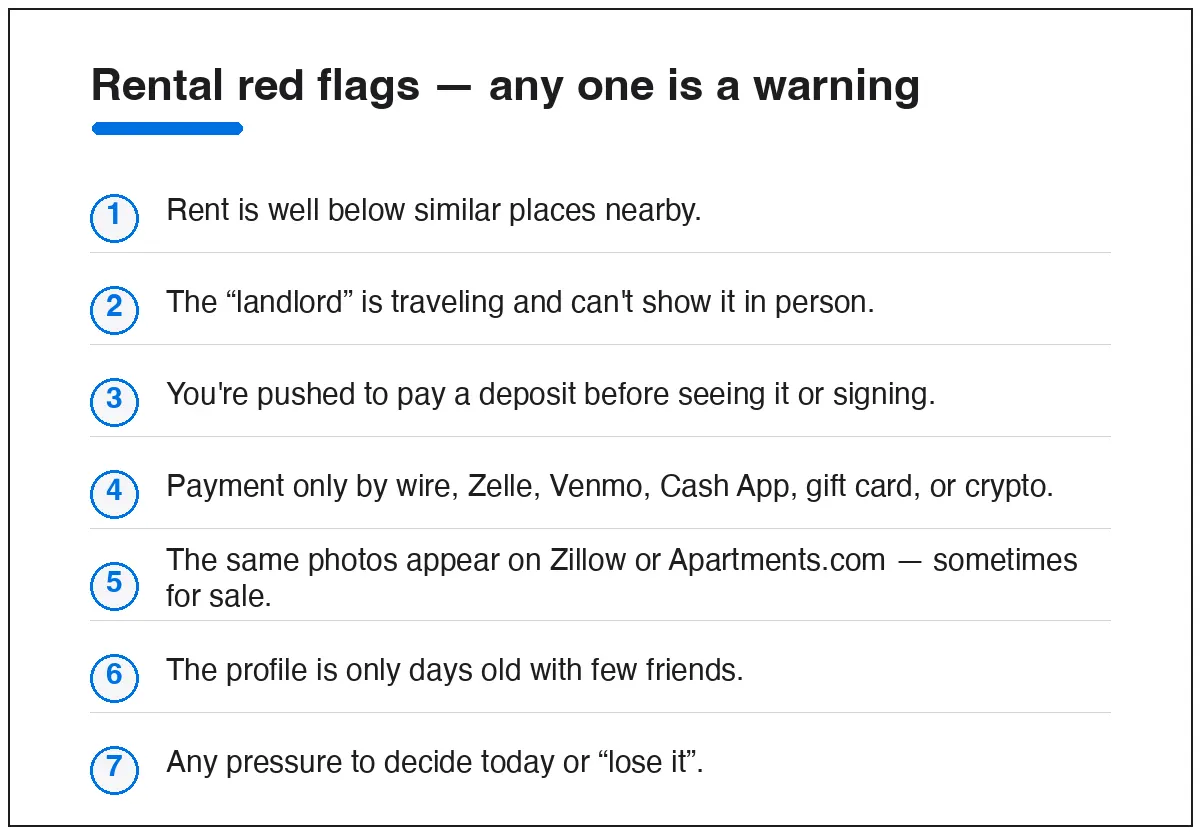
- Priced below the neighborhood. If it’s a lot cheaper than similar units nearby, ask why — cheap is the bait.
- Can’t view it in person. A real landlord or agent will let you (or someone you trust) walk through before any money moves.
- Deposit demanded up front, before a viewing or a signed lease.
- Untraceable payment only — wire, Zelle, Venmo, Cash App, gift card, or crypto. These are chosen precisely because you can’t reverse them.
- Photos appear elsewhere. Reverse-image-search a photo or search the address; if the same place is on Zillow or Apartments.com — especially for sale — it’s a copy.
- Brand-new profile, days old, few friends, no local history.
- Pressure to decide today or “someone else will take it.”
How to rent safely on Marketplace
- See it before you pay — in person, or at minimum a live video walk-through where they show specific things you ask for.
- Verify the owner. Look up the address in public property records to check the name matches who you’re dealing with.
- Search the listing. Drop the address and a photo into Google; a match on a real estate site at a different price is a red flag.
- Sign a real lease before any deposit, and pay by a method with a paper trail — never gift cards or crypto.
- Trust the pressure signal. Anyone rushing you off the normal process is the reason to slow down.
If you already paid
Act fast: contact your bank or payment provider to attempt a reversal, report the listing and profile to Facebook, and file with the FTC and local police. Full sequence: what to do if you’re scammed on Facebook Marketplace.
Quick answers
Are rentals on Facebook Marketplace safe?
Some are legitimate, but Marketplace carries a high share of rental fraud. Treat any listing as unverified until you’ve seen the place and confirmed who owns it.
Why won’t the landlord let me see the apartment?
A real one will. “Out of town,” “keys with a manager,” and “just pay to hold it” are the standard scam scripts. No viewing, no money.
Is a deposit request before viewing always a scam?
Very close to always. Legitimate landlords collect a deposit at lease signing, after you’ve seen the unit — not to “reserve” a place sight unseen.
How do I check if a rental listing is real?
Reverse-image-search the photos, search the street address, and confirm the owner’s name in public property records. Copies and mismatches are the tell.
This is one type in a larger pattern — see the full Facebook Marketplace scams guide, and the payment traps in Venmo and Zelle scams.